Insider Risk and Access to Business Data
Review privilege creep, former employee access and the permissions that can quietly expose sensitive business information.

· Last updated
From our archive: Originally published November 06, 2025. Product features, pricing and availability mentioned in this article may have changed.
Who Has Your Keys? Why “Privilege Creep” is a Silent Risk for Your Business
Let me ask a question that might keep you up tonight. Do you know *exactly* who can access your company’s payroll files right now? What about your client list?
If you’re like most business owners, you probably assume your IT setup handles this. However, new research shows a dangerous reality. Studies reveal that around half of all employees have access to far more sensitive data than they need to do their jobs.
For business owners in Canton, Akron, and across Northeast Ohio, this is a silent but massive vulnerability. It’s known as “insider risk.”
The Biggest Threat Isn’t Malice, It’s a Mistake
“Insider risk” doesn’t always mean a disgruntled employee stealing data (though that happens). In fact, the threat is far more often unintentional.
It’s the loyal, hardworking manager who accidentally clicks a sophisticated phishing email. Their account has access to *everything* - HR, finance, and operations. As a result, that simple mistake instantly becomes a catastrophic, company-wide data breach.
When an employee can see data they don’t need, it opens the door to problems. This can lead to accidents, compliance failures, and embarrassing breaches.
The Silent Culprit: “Privilege Creep”
This problem doesn’t happen overnight. It has a name: **”Privilege Creep.”**
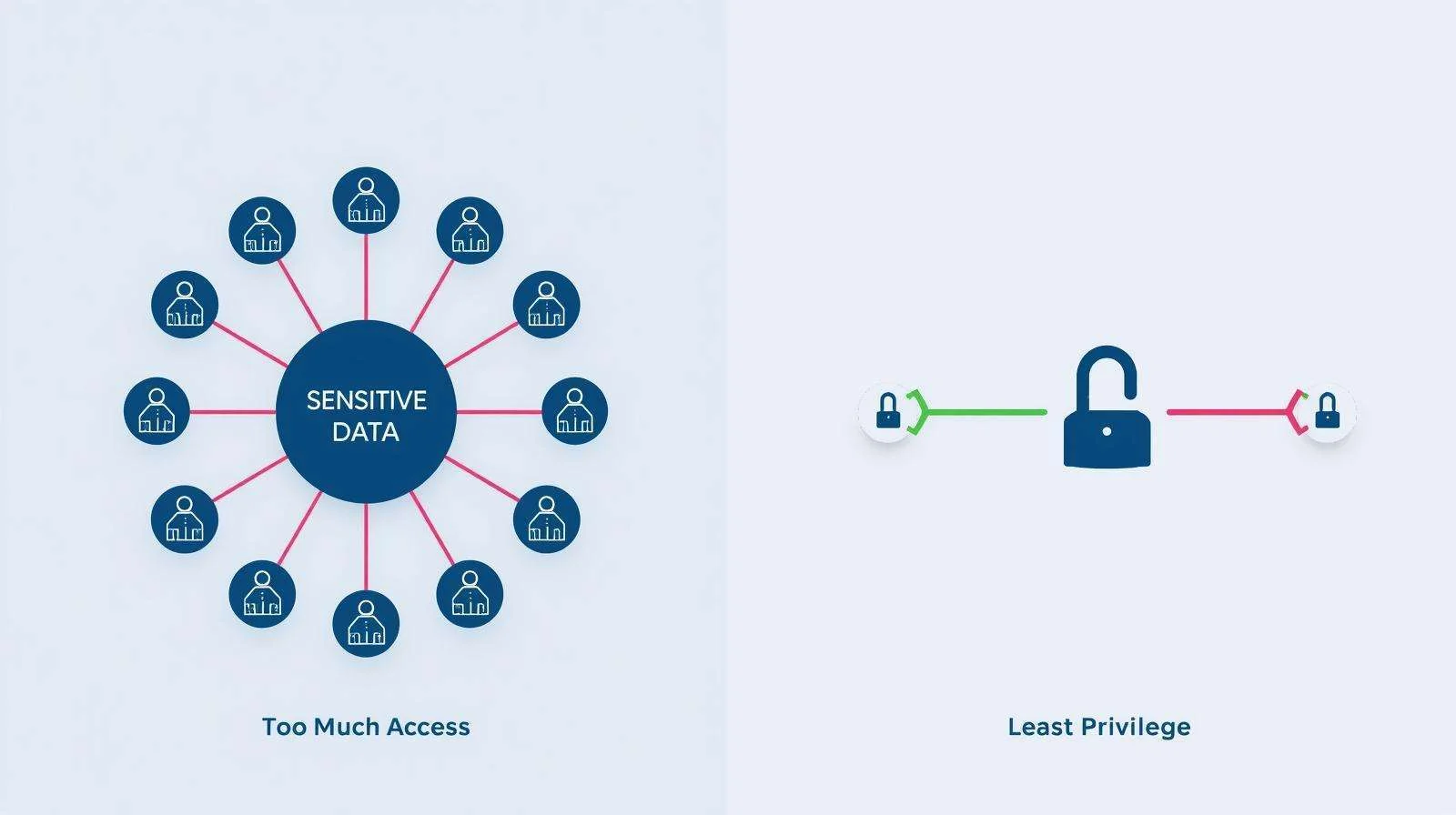
It happens slowly, month after month. For example, an employee starts in sales, so they get access to the customer list. A year later, they move to management and get access to team performance files. Then, they help HR with interviews and get temporary access to payroll data.
With each move, they collect new access permissions. But does anyone ever go back and *remove* the old ones? Usually not.
Consequently, before you know it, one person has the “keys” to your entire kingdom. And no one even realizes it.
Here’s something even scarier. Nearly half of businesses admit that some **ex-employees still have access** to company systems *months* after leaving. That’s like leaving a key to your office with someone who now works for your competitor.
The Solution: A “Need-to-Know” Policy
The solution to this problem is a foundational security concept. It’s called the **”Principle of Least Privilege” (PoLP).**
It’s a simple rule. Your team should *only* have access to the exact information they need for their daily job. Nothing more.
Your marketing intern doesn’t need to see your financial statements. Likewise, your sales manager doesn’t need access to the HR folder. This isn’t about trust. It’s about smart security. Ultimately, by limiting access, you limit the potential damage from a mistake or a compromised account.
A second, critical piece is a rock-solid **employee offboarding process**. The *moment* an employee gives their notice, you need a checklist. This process must revoke all their access on their last day. No exceptions.
Don’t Wait for a Breach to Find Out Who Has Your Data
Managing this is harder than ever in today’s world of cloud apps and AI tools. However, it’s not impossible. It just requires a proactive plan.
The goal isn’t to slow your team down with red tape. Instead, it’s to protect your data, your customers, and your business’s hard-earned reputation.
Can you say with 100% certainty who has access to your most sensitive files? If not, it’s time for a check-up.
Contact Cyber Shift Technologies today for a consultation. We can help you audit your company’s permissions. Together, we can build a secure access policy for your Northeast Ohio business.